




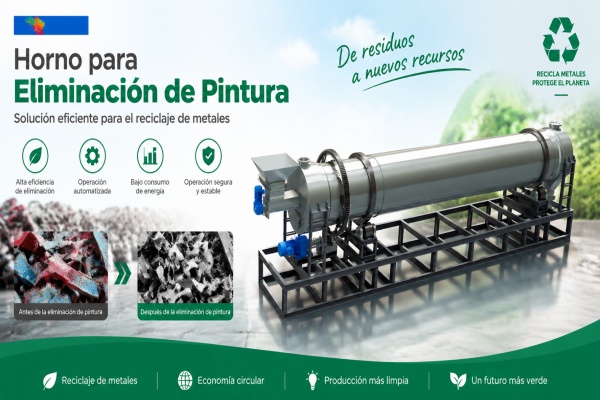
Continuous deglazed horn for UBC cans
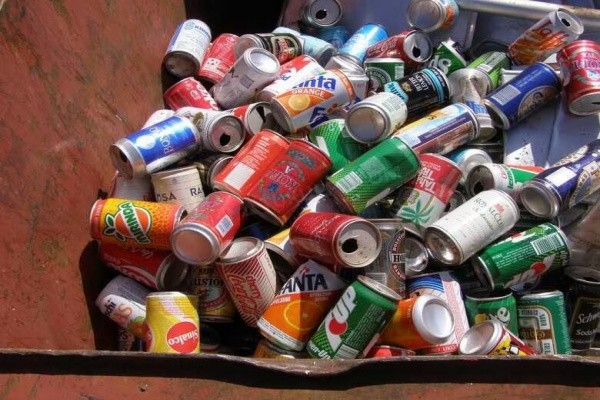
Reciclar latas de aluminio usadas no consiste únicamente en introducirlas directamente en un horno de fusion. The lacquers, paints, humidity, plastic, iron and other residues can increase smoke, slag formation, energy consumption and metal loss.
When these problems appear continuously, increasing the oven temperature does not usually solve them. On the contrary, can increase aluminum oxidation and reduce final recovery.
Our objective is not only to supply a continuous descaling oven. We ensure that each stage correctly prepares the material for the next and that the entire line maintains a capacity, stable energy consumption and product quality.

How is the entire process organized from UBC to bullion??
He complete process from UBC to bullion integrates several treatment stages to remove coatings and impurities, recover clean aluminum and obtain a final product prepared for industrial reuse.
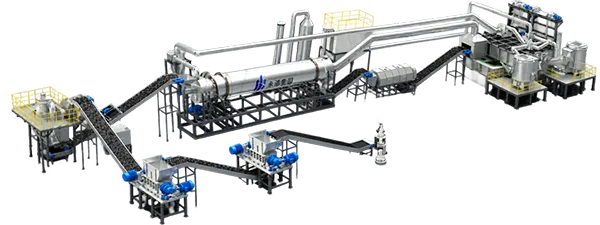
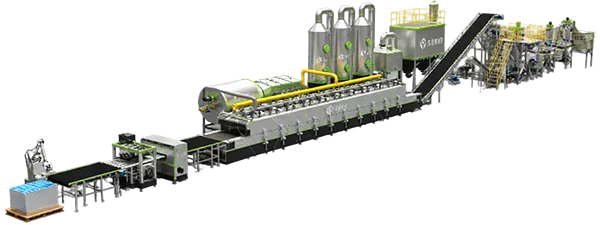
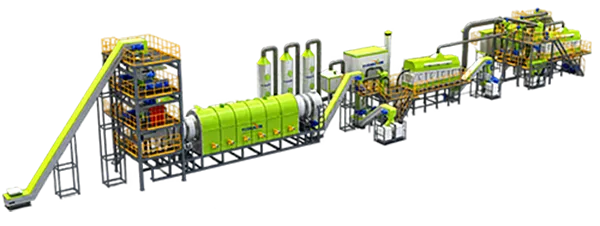
The process includes the trituration, Secondary crushing,the separation and cleaning, he thermal peeling, he drum screening, the aluminum melting y, finally, gas treatment and purification.

01. Trituration
Reduction of material to ≤ 50 mm

02. Separation and cleaning
Metal removal, dust and other impurities

03. Thermal peeling
Paint removal, paints, oils and resins at 400–600 °C

04. Drum screening
Ash separation, dust and charred residue

05. aluminum fusion
Transfer of clean aluminum to the melting furnace
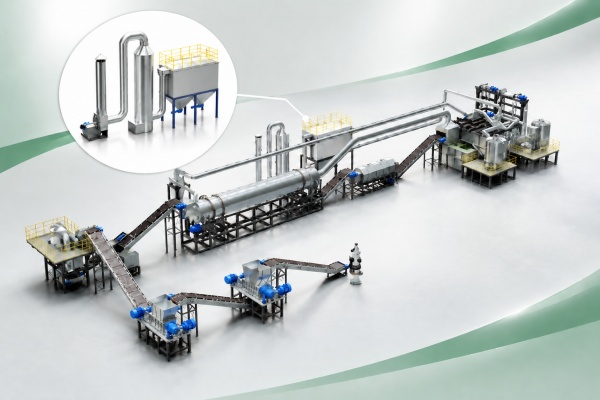
06. Gas treatment and purification
Control of thermal process emissions
¿Cómo funciona el deslacado térmico continuo?
Después del pretratamiento, las escamas entran en el horno mediante un sistema de transporte y alimentación estanca.
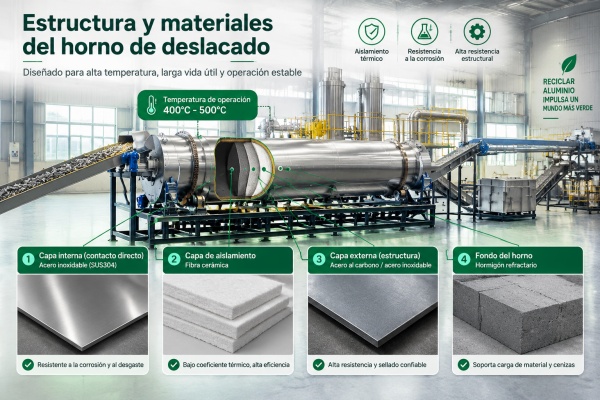
Dentro del tambor rotativo, el material avanza mientras cambia continuamente de posición. Los gases calientes transfieren energía sin aplicar directamente la llama sobre las escamas de aluminio.
El proceso suele trabajar dentro de un rango aproximado de 400–600 °C. En estas condiciones, lacas, paints, aceites y resinas se descomponen, volatilizan o carbonizan antes de separarse del metal.

Pero la temperatura no determina por sí sola el resultado:
Como valores iniciales de referencia, podemos trabajar con un contenido de oxígeno inferior al 2 % y un tiempo de residencia aproximado de 30–50 minutos. Los valores finales se ajustan a las condiciones reales del material.
Main advantages and innovations
What happens to the UBC after the detachment?
After heat treatment, a screening system can remove residual carbon, ashes and loose particles.
From this point there are two main routes.
Cooling of the scales
The deglazed aluminum can be cooled and stored for sale or further processing.

Transport to the fusion
When the plant already has a suitable oven, we can configure a closed transport between decoupling and merging. This route allows you to conserve part of the heat of the material and reduce its unnecessary exposure to the environment..

What keeps continuous production stable??
That's why, our PLC coordinates the feeding, drum speed, the fan, pressure and gas recirculation instead of just controlling a fixed temperature.
Is it advisable to build a new line or modernize an existing plant?

A new line allows pretreatment to be jointly designed, the detached, the fusion, casting and gas treatment.
We can unify the interfaces, centralize automation and more easily balance the capabilities of all teams. This solution offers greater integration, although it also requires more investment, surface, foundations and auxiliary services.
Modernization may be more convenient when the customer already has an aluminum oven in good condition..
In this case, we check the real capacity of the oven, the charging system, the side well, the refractory, the temperature and composition of gases, the available space, smoke collection, the electrical power and the PLC interfaces. We also define the path of the hot scales and the necessary stop to connect the new equipment.

Soluciones de deslacado de aluminio según capacidad de procesamiento
Cada planta de reciclaje tiene diferentes necesidades de producción. Explore las soluciones de deslacado de aluminio según la capacidad requerida, el tipo de chatarra y las condiciones de operación de su proyecto.

 English
 Español
 Français
 Italiano
 Português
 Português do Brasil