




Complete line for deslamming and melting cans UBC
Do you need to convert used cans in marketable ingots, but you are worried about aluminum losses, gas consumption and emissions? Our complete recycling line from UBC cans to ingots connects crushing, separation, thermal peeling, fusion, refining and casting.
At Yushunxin we design each stage according to the quality of your UBC, required production and ingot specification. So, can evaluate a complete installation with metal recovery indicators, energy and salable product.
Which companies need a complete UBC line?
An aluminum recycling plant must justify its investment through tons of marketable product. That's why, the decision does not depend solely on the deslacking oven. The quality of the material received also influences, the existing equipment and the aluminum sales contract.
How does UBC quality influence setup and performance??
Two bales of the same weight can contain different amounts of recoverable aluminum. Besides, humidity, plastic and ferrous materials increase separation loads. Therefore, the receiving specification must be established before sizing the thermal equipment.

Metal content of UBC bales
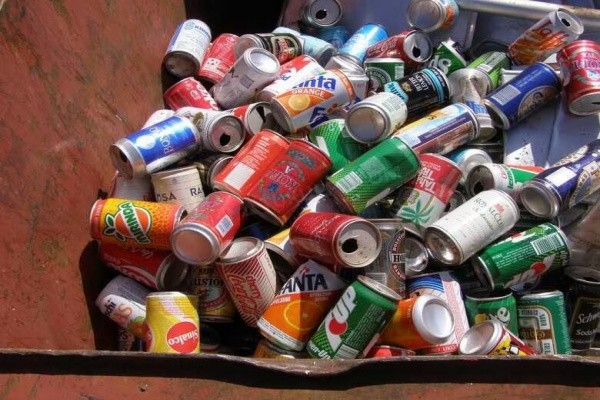
We work with used aluminum cans for drinks (UBC), loose or compacted.
During sampling we check metallic content, humidity, density and foreign materials. We also record residual liquids and variations between suppliers.
For example, 3 tons of UBC with a 94 % of metallic content theoretically contain 2,82 tons of aluminum. The remainder should not be included in the calculation of recoverable metal.
Plastic labels and chlorine contaminants
Retractable sleeves, labels and other plastic waste can modify the composition of gases.
If there are materials with chlorine, the treatment of acid gases should also be evaluated. For this reason, pre-classification protects both the thermal process and the environmental system.

Complete UBC recycling process
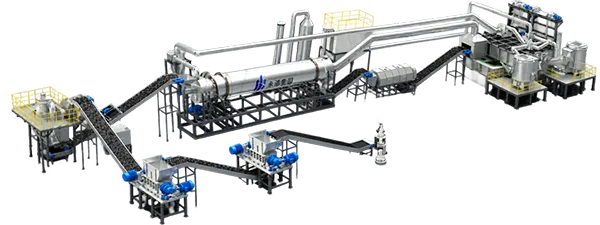
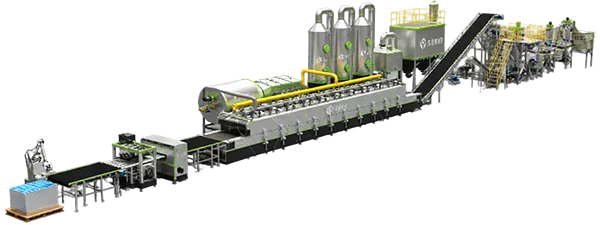
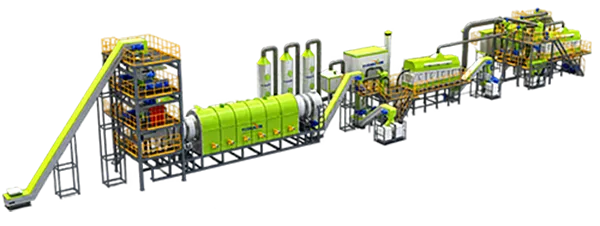
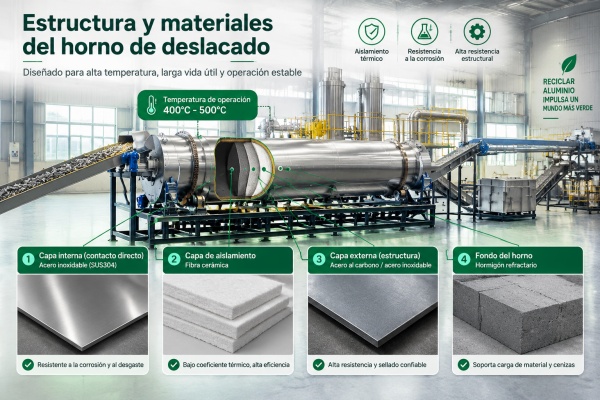
The continuous rotary stripping kiln works in a closed, oxygen-poor atmosphere.. The reference temperature is between 400 y 600 °C. Meanwhile, aluminum remains below its approximate melting point of 660 °C. The paintings, inks and films organics decompose during pyrolysis. Temperature control, oxygen and system pressure helps limit oxidation. technique presents a deslagging rate higher than 99 % as a reference for certain configurations.
The process includes the trituration, Secondary crushing,the separation and cleaning, he thermal peeling, he drum screening, the aluminum melting y, finally, gas treatment and purification.

01. Opening of bales and crushing less than 3 cm
The process begins with a high-torque crusher that breaks up the compacted blocks.. After, A specific metal crusher reduces the material to less than 3 cm. A controlled granulometry favors heat transfer and stabilizes the deslaking. Besides, we must monitor the production of fines to avoid aluminum losses during separation.

02.Pneumatic and magnetic separation
high intensity magnetic separation removes ferrous particles. So, reduces the risk of oven wear and improves feed cleanliness. When the mix requires it, We can also study an eddy current separator for UBC. Its incorporation depends on the impurities and the expected recovery of aluminum..

03. Temperature, oxygen and coating removal
The continuous rotary stripping kiln works in a closed, oxygen-poor atmosphere.. The reference temperature is between 400 y 600 °C. Meanwhile, aluminum remains below its approximate melting point of 660 °C. The paintings, Organic inks and films decompose during pyrolysis. Temperature control, oxygen and system pressure helps limit oxidation. technique presents a deslagging rate higher than 99 % as a reference for certain configurations.

04. Separation of ashes and carbonaceous fines
The treated material then passes through a dedusting drum. This equipment physically removes ashes and carbonaceous residues adhered to the aluminum flakes.. So, improves feed cleanliness before melting. We must also measure the aluminum carried with the waste. High cleanliness does not compensate for excessive metal losses.

05. aluminum fusion
The fusion cycle is around eight hours, with casting at 730–760 °C. If the fusion works in batches and the deglazing works continuously, may require buffering.
06. Gas treatment and purification
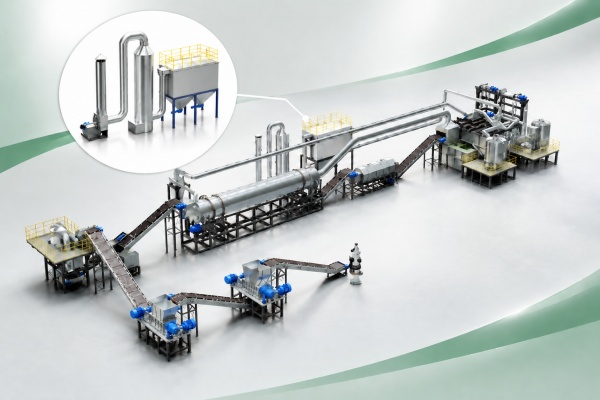
combines high temperature oxidation, rapid cooling, particle capture and washing. For reference, contemplates thermal destruction of dioxins above 800 °C and cooling below 200 °C. NOx inferior a 100 mg/Nm³ and particles less than 10 mg/m³. The system can integrate cyclone, bag filter and wash for desulfurization and defluorination.
See how our UBC can recycling line works
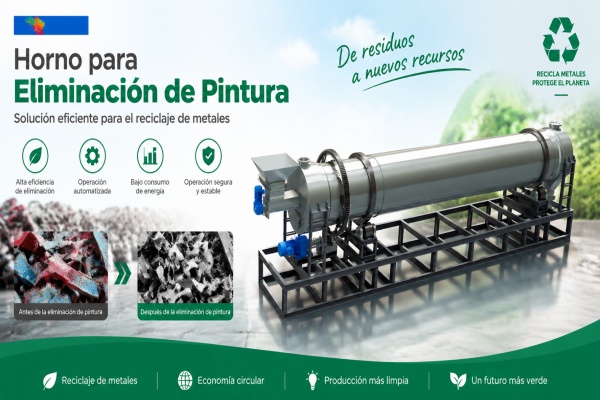
See how UBC can paint removal process before casting works. At this stage, used aluminum cans go through a paint removal oven to remove coatings, paints and other organic surface components. This pretreatment facilitates the preparation of aluminum for the subsequent stages of casting and ingot production.. The video shows the real operation of a continuous paint removal line from UBC cans and its integration into the aluminum recycling process.
How to obtain greater metal recovery during UBC smelting?
Aluminum flakes are light and can float on the molten pool. If they remain exposed to air, increases the risk of oxidation. For this reason, the configuration of the melting furnace must facilitate its immersion and limit the formation of slag.

The stripping oven can be configured with internal or external heating. Natural gas is generally used, although liquid fuel or electricity can also be selected.
How does the integrated system reduce natural gas consumption?
Stripping and smelting require large amounts of thermal energy. If they work as independent systems, part of the heat is lost. That's why, Our solution takes advantage of the hot gases from the melting furnace and recovers fuel from the pyrolysis process.

Melting Furnace Heat Recovery
The hot combustion gases from the aluminum furnace are led to the descaling system.
There they provide part of the heat necessary for pyrolysis.. Besides, This connection can reduce the external fuel demand during stable operation.
The thermal circuit must be designed according to the flow, the temperature and real needs of both ovens.
Reuse of fuel gases
The stripping process generates combustible gases that can be used for energy.
First, These gases pass through a cyclone that removes the entrained particles. After, return to the combustion system of the melting furnace.
our integrated solution contemplates an overall natural gas consumption of approximately 60–65 Nm³ per ton of finished aluminum.

Why producing ingots can generate more
value to sell deglazed aluminum?
Crushed or deglazed aluminum still requires additional operations before becoming a marketable cast product.. Instead, ingots allow delivering an alloy with composition, defined weight and identification. That additional processing can increase the commercial value of the recovered material.
What emissions data should you check before installing the line?
The painting, plastic films and other contaminants generate gases during heat treatment. Besides, Its composition may change between providers. That's why, The environmental system must be designed according to the pollutant load and the limits required at the installation site..
Gas treatment through double regenerative system
Our configuration integrates centralized collection of process gases.
First, the gases pass through a regenerative chamber of the melting furnace, where its temperature increases. After, enter the combustion chamber to oxidize organic compounds.
Next, pass through another regenerative chamber and cool rapidly. Dual regeneration system uses a four-way diverter valve to alternate combustion and evacuation.
Finally, an induced draft fan drives the gases to the pulse dust removal system. They then undergo acid washing by spraying before discharge.

Environmental reference values for secondary aluminum:
The BAT conclusions of the European Union, Decision 2016/1032, include the following levels associated with certain secondary aluminum operations:
| Service | Engineering requirement |
|---|---|
| Gas natural | Flow rate and pressure for expected conditions |
| Electricity | Installed power and operational demand |
| cooling water | Caudal, temperature and quality |
| Compressed air | Equipment pressure and consumption |
| Nitrogen | Availability depending on the refining process |
| PLC/SCADA | Coordination of equipment and registration of parameters |
| Environmental treatment | Gas flow, filtration and washing |
Scope of supply and project services
Our scope covers from initial engineering to commissioning, ensuring
integration complete system of continuous thermal stripping line
Benefits of converting UBC to bullion
The transformation of used aluminum cans (UBC) in ingots allows the recovery of a high-quality material
value and adapt to current trends in circular economy and sustainable waste management.
What aluminum stripping capacity does your plant need??
Compare our aluminum stripping solutions 1 y 10 t/h, designed for different scrap volumes and production needs. Evaluate equipment configurations, feeding, thermal control, gas treatment and integration with the foundry to find a solution suitable for your plant conditions.

 English
 Español
 Français
 Italiano
 Português
 Português do Brasil